What does it take to balance university studies, a career, and serious endurance training? For our BSc (Hons) Business Management student Marco Karim, it means finding a rhythm that allows him to pursue ambitious goals both inside and outside the classroom.
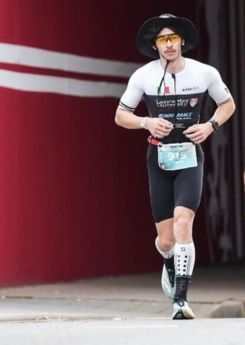
At just 20 years old, Marco took on IRONMAN 70.3 Leipzig, completing 1.9 km of swimming, 90 km of cycling and 21.1 km of running – 70.3 miles in total. The race was particularly meaningful for Marco as it took place in Leipzig, the city he has called home while studying at Lancaster University Leipzig since 2024. With the Lancaster University Leipzig community supporting him along the route, he experienced the city from a very different perspective.
In the following article, Marco reflects on his experience of taking on the race just four weeks after surgery, while balancing his studies, work, CFA and MIT MicroMasters commitments with triathlon training. He also shares what studying and living in Leipzig has meant for his training – and how the people and environment around him have helped shape his approach to ambitious goals.

Took it home! IRONMAN 70.3 Leipzig, four weeks after surgery. It wasn’t a calculated decision — more like the convergence of a home race, decent recovery, and the kind of stubbornness that comes with being deep in endurance training.
The actual logistics of balancing study, work, and serious triathlon aren’t particularly interesting. Working in fund strategy, pursuing my BSc, CFA, MicroMasters at MIT, and training seriously for triathlon at least sounds more impressive. Point is, eventually you find a rhythm. Early morning swims before anything else happens, focused sessions instead of volume, the ability to think through problems on a bike while clocking kilometers. It works if you’re disciplined about protecting training time among all else. But the real thing that makes it sustainable is being around people doing similarly ambitious things. That changes the baseline for what’s normal.
When your circle is Oxbridge overachievers, MDs that run marathons after deal weeks, and even clients who sign up for races with you, the whole thing becomes less like individual stubbornness and more like standard practice. It would take commitment not to make it in an environment like that. Stay around people who do what you do and are who you want to be—that’s pretty much it.
What’s more relevant is that I was doing this from Leipzig, which actually matters. Not for romantic reasons—just practically. The city has solid pools, good running routes, and cycling infrastructure that doesn’t require heroic effort to navigate. When you’re training seriously while everything else is pulling your attention, having infrastructure that makes training logistically simple removes one additional layer of friction.
The cost side of triathlon deserves honesty. By the time you’re at IRONMAN, you’re spending serious money—TT bikes, wetsuits, coaching, nutrition, race fees. I can absorb that cost as, at the end of the month “Sleeping with my eyes open” as my boss calls it, shows up fairly in my paycheck. That’s an advantage I’m aware of. But triathlon itself doesn’t require that spend to start. I know plenty of people who’ve hit it off quite well on a “budget”. Well, depending on your definition of a budget!
Eliminate things that don’t matter and commit fully to things that do.
The surgery thing shifted the equation. Racing four weeks post-op wasn’t medically recommended, and deferring would have been the sensible call. But this was Leipzig, where I studied at Lancaster University Leipzig and built many of the values I still rely on. Lancaster coming onboard this was an additional reason to decide I’d listen to the only doctor that said I was allowed to do it from day one.
The actual finish wasn’t remarkable. Decent time given the circumstances, it was the community support that made it feel less like individual achievement and more like collective effort. From the fellow athletes to the crowds, an Ironman is truly an experience as an athlete. What stuck was the realization that balancing all of this works not because time management is particularly clever, but because you eliminate things that don’t matter and commit fully to things that do. Work, study, training, recovery. Pick what’s non-negotiable and defend it. Everything else adapts or doesn’t happen.
It’s not sustainable as a permanent state, which is worth being clear about. But to service a specific goal in your 20s, anything is possible if you’re willing to live in some comfortable perpetual tension and be honest about what gets sacrificed. With two more Ironmans, one MIT MicroMasters exam, a CFA exam, and my last BSc year scheduled for 2027, the rhythm is becoming clearer with each one.
The challenge shifts from “can I do this?” to “how do I do this well while everything else is also demanding excellence?” That’s a different kind of problem.