BSc Business Management with Entrepreneurship will develop your entrepreneurial mindset and creative skills to prepare you for a future in business.
Full time 3 or 4 years
Direct BSc entry: 3 academic years
Foundation entry: 4 academic years
English
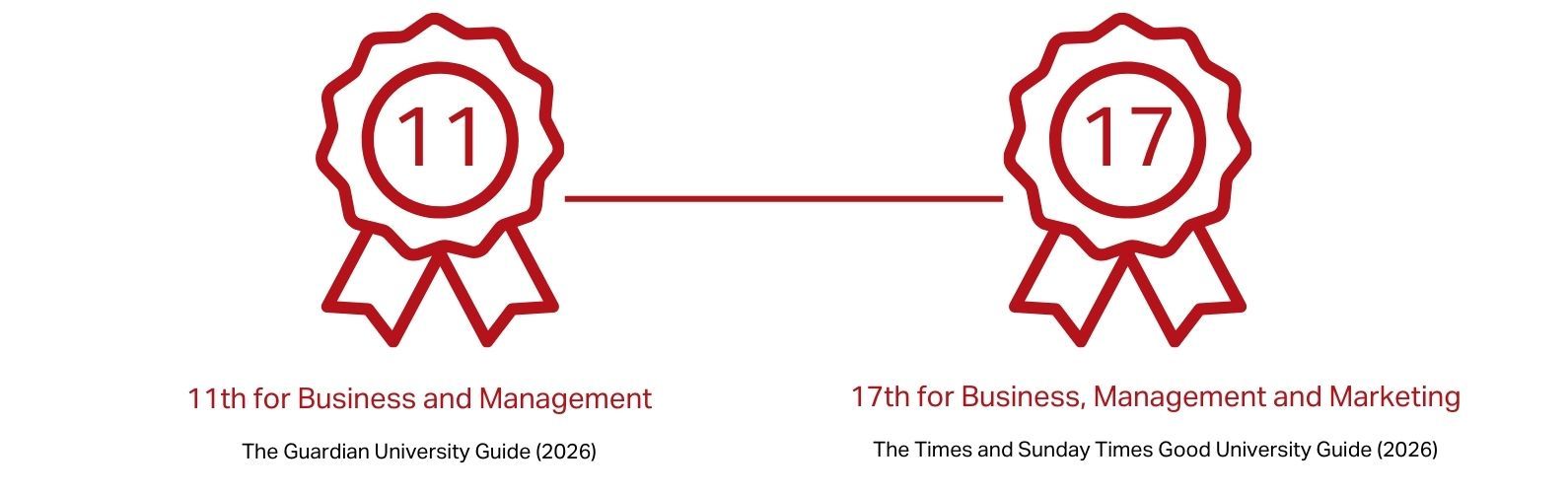
Lancaster University degree is highly ranked in the UK and globally.
BSc Business Management with Entrepreneurship will teach you how to think like an entrepreneur. The course will provide you with a perfect blend of theory and practice, covering topics such as:
You will engage in ideation, innovation, and creation. You will build resilience and confidence. Whether you plan to create your own business or be entrepreneurial within an existing company, you will learn how to be a responsible leader who can navigate through any situation.
This course develops your academic, practical, and professional skills. Interactive lectures will deliver key knowledge, while practical workshops and live-action simulations allow you to apply these concepts in real-world scenarios. There is a mix of independent study to develop your critical thinking and group work to build teamwork and communication skills. You will learn to evaluate and analyse information to produce reports and reflective essays. You will develop your confidence in articulating ideas and delivering professional content through pitches and presentations.
You will learn about the wider environmental, political, and economic challenges that are both impacted by and impact on the way we do business. On this research-led degree you will be immersed in exploring and tackling major global challenges, with emphasis on sustainability and social justice.
Programme structure: We continually review and enhance our curriculum to ensure we are delivering the best possible learning experience, and to make sure that the subject knowledge and transferable skills you develop will prepare you for your future. The University will make every reasonable effort to offer programmes and modules as advertised. In some cases, changes may be necessary and may result in new modules or some modules and combinations being unavailable. Not all optional modules are available every year.
Introduction to Financial Accounting for Managers
In this module, you will be introduced to the analysis and use of published financial statements. You will explore the concepts underlying financial reporting by companies and gain an understanding of the financial environment in which they operate, developing the skills to work effectively as a future non-accounting manager alongside your accounting colleagues in cross-functional management teams.
By the end of this module, you will be able to:
Economics for Business
In this module, you will be introduced to the discipline of Economics, exploring how a modern economy functions at both the microeconomic level, by examining the behaviour of individuals and firms, and the macroeconomic level, where aggregates such as national income, unemployment, and inflation are the focus of attention.
By the end of this module, you will be able to:
Entrepreneurship: Innovating New Futures
In this module, you will develop an introductory understanding of entrepreneurship and innovation, exploring key concepts such as creativity and customer need, understanding value, accessing resources, new venture creation, scenario planning, and learning from failure.
You will gain hands-on experience of a range of entrepreneurial skills that are transferable across many contexts, whether you are establishing a startup, taking an entrepreneurial approach to your own career, or working within government or the social enterprise sector. You will also develop broader skills in communication, presentation, writing, and reflecting on your own practice.
By the end of this module, you will be able to:
Principles of Marketing
In this module, you will examine the key elements of marketing theory and practice and how these connect with other aspects of business management. The module is organised around three themes. The first introduces the fundamentals of marketing, including the branding and pricing of products and services. The second explores the competitive marketplace, focusing on how organisations understand and engage with consumers, including recent developments in digital marketing. The third consolidates your learning by considering how marketers obtain and use information to inform innovation and the marketing planning process.
By the end of this module, you will be able to:
Introduction to Management
In this module, you will be introduced to both traditional and contemporary ideas about management and leadership, exploring a range of theories and practices relevant to the organisation of work. You will examine and contrast major trends in management and leadership thinking, considering the relationship between theory and practice in key emerging areas, and engaging with current issues and debates in the field. The module also provides a supportive environment in which you can develop, test, and explore your own theories and managerial and leadership skills.
By the end of this module, you will be able to:
Introduction to Business Analytics
In this module, you will be introduced to the core ideas and practical tools of business analytics, exploring how data can support better decisions in organisations. You will examine what data is, how it is collected, and how sampling works, before learning how to visualise data using charts and graphs and describe patterns using measures of averages, variation, and relationships. As the module progresses, you will model links between variables through simple and multiple regression and apply basic forecasting techniques to support planning.
By the end of this module, you will be able to:
Employability and Careers I
In this module, you will take the first steps in preparing for your future career as a Business Management graduate. Combining insights from visiting employers with structured employability preparation, the module focuses on two interconnected themes: Opportunity Awareness, exploring the career opportunities available to you as a Business Management graduate, and Self-Awareness, reflecting on your personal interests, motivations, values, and skills. You will also be introduced to the graduate labour market and the careers information, resources, and support available to you throughout your studies.
By the end of this module, you will be able to:
Programme structure: We continually review and enhance our curriculum to ensure we are delivering the best possible learning experience, and to make sure that the subject knowledge and transferable skills you develop will prepare you for your future. The University will make every reasonable effort to offer programmes and modules as advertised. In some cases, changes may be necessary and may result in new modules or some modules and combinations being unavailable. Not all optional modules are available every year.
Entrepreneurial Mindset
In this module, you will develop your entrepreneurial mindset through an active pedagogy of vicarious learning. You will also develop an understanding of how entrepreneurs learn and develop their mindset, with the aim of provoking reflection on your own mindset in the context of your professional career.
By the end of this module, you will be able to:
Personal Leadership Development
In this module, you will develop an understanding of the contexts of leadership and begin to form your own personal and professional leadership philosophy. You will be introduced to the major leadership models and real-life case studies, undertake self-assessments across a variety of leadership measures, and engage in activities designed to develop your leadership skills. You will also explore the importance of personal characteristics to effective leadership.
By the end of this module, you will be able to:
Skills for Entrepreneurship
In this module, you will develop a critical understanding of the key concepts underpinning the development and selling of a new product, approached through an interactive and collaborative lens. Taking a broad and holistic view of the entrepreneurial process, you will explore the agency and activities of the entrepreneur as the main driver of new products and businesses.
By the end of this module, you will be able to:
Business Start-up
In this module, you will develop an advanced understanding of entrepreneurship and intrapreneurship in the complex context of new venture creation. You will build the ability to develop and communicate new business ideas using opportunity-led business models, and enhance your knowledge of digital marketing in the context of business start-up.
By the end of this module, you will be able to:
Social Innovation Challenge
In this module, you will develop a broad theoretical and practical understanding of social innovation and explore how innovation can be integrated into an organisation’s business model. You will also develop an awareness of the leadership and team behaviours that enable a business to succeed beyond financial profit.
By the end of this module, you will be able to:
Innovation: Product, Service, and Business Model
In this module, you will explore innovation across multiple levels, from the role of innovation in enabling individuals to generate competitive advantage through to the strategic challenges firms face in new product, service, and process development. You will develop a critical awareness of current theories and approaches relevant to managing innovation in products and services.
By the end of this module, you will be able to:
Employability and Careers II
In this module, you will build on the foundational employability knowledge and skills developed in your first year, progressing your preparation for the graduate job market. You will deepen your career research skills, develop your professional network, and refine the practical tools and techniques needed to compete effectively for graduate roles.
By the end of this module, you will be able to:
Optional Modules (to choose 2 from)
Programme structure: We continually review and enhance our curriculum to ensure we are delivering the best possible learning experience, and to make sure that the subject knowledge and transferable skills you develop will prepare you for your future. The University will make every reasonable effort to offer programmes and modules as advertised. In some cases, changes may be necessary and may result in new modules or some modules and combinations being unavailable. Not all optional modules are available every year.
Principles of Strategic Management
In this module, you will develop an understanding of strategy that enables you to discuss real-life business activities within a framework of contemporary strategic management thinking. You will be encouraged to develop a personal and distinctive understanding of strategising across different industries and in uncertain environments.
By the end of this module, you will be able to:
Entrepreneurial Finance and Business Planning
In this module, you will develop an understanding of the nature and characteristics of financial planning and management in the context of entrepreneurship and small business. You will explore the process of new venture financing and the finance needs of growth, with a particular emphasis on cash flow and working capital management and on investment strategies.
By the end of this module, you will be able to:
Family Business
In this module, you will develop an understanding of the concepts, theories, behaviours, and dynamics of family firms, and explore how these can be applied to address challenges related to family business continuity.
By the end of this module, you will be able to:
Entrepreneurial Challenge
In this module, you will define and deliver a research project, business plan proof of concept, or company project, translating your findings for a wider public audience through the development of magazine article writing skills.
By the end of this module, you will be able to:
Optional Modules (to choose 3 from)
Programme structure: We continually review and enhance our curriculum to ensure we are delivering the best possible learning experience, and to make sure that the subject knowledge and transferable skills you develop will prepare you for your future. The University will make every reasonable effort to offer programmes and modules as advertised. In some cases, changes may be necessary and may result in new modules or some modules and combinations being unavailable. Not all optional modules are available every year.
Teaching is delivered via a combination of small group lectures and group-based tutorial coursework. You will be encouraged throughout to undertake independent study to supplement what is being taught/learnt and to broaden your personal knowledge.
German language skills are not required for admission into the programme. You will learn in English, and converse with classmates and academics in English.
All BSc (Hons) Business Management with Entrepreneurship students will receive their undergraduate degree from Lancaster University’s Bailrigg campus in the UK.
Our tuition fee is set for a 12-month time frame encompassing one academic year.
There are two types of fees at Lancaster University Leipzig:
The tuition fee that you will pay depends on your citizenship or your immigration status. International citizens with legal residence in the EU/UK or a EEA member country will be assessed for EU/UK fee status on a case by case basis. The admissions department will provide you with more guidance regarding the fee status review during the application assessment stage.
Eligible students may benefit from various funding options available at Lancaster University Leipzig. Explore what options you may be qualified for.
You will graduate from BSc Business Management with Entrepreneurship with the qualities, skills and insights required to start your career in business, whatever path you choose to take.
Lancaster University graduates in the UK have been successful in many areas of business management, entrepreneurship, and consultancy. Recent graduates have started their own businesses or gained employment at major companies including:
Some graduates have had brilliant careers in smaller businesses, such as their own family businesses, public sector institutions, non-profit organisations, government agencies, and the civil service.
This course has also proved to be a powerful springboard to postgraduate education and further academic study at Lancaster and other prestigious universities worldwide.
For information, visit the Careers Centre at Lancaster University Leipzig.
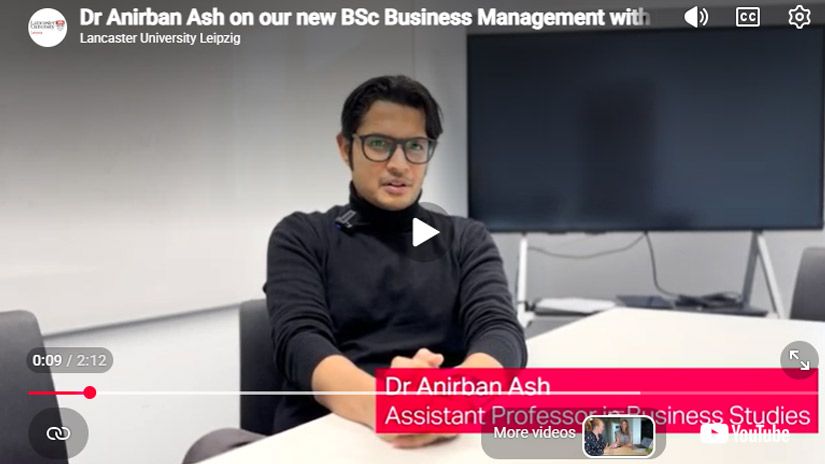
This programme prepares future business owners for all aspects of it. Hear from Dr Ash, Assistant Professor in Business Studies, what makes the new degree so practical.