We live in a world where analytical decision-making happens every second. Data is collected about everything to construct, operate and maintain systems. If you want a career in data or business analytics, decision support, industrial engineering or management science, our MSc Business Analytics is ideal for you.
Full time 1 academic year
English
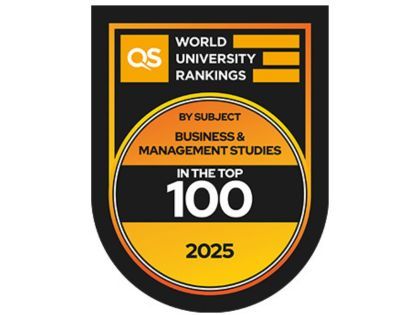
Lancaster University is ranked 13th in the UK and joint 99th globally for Business and Management according to the QS World Rankings by Subject 2025.
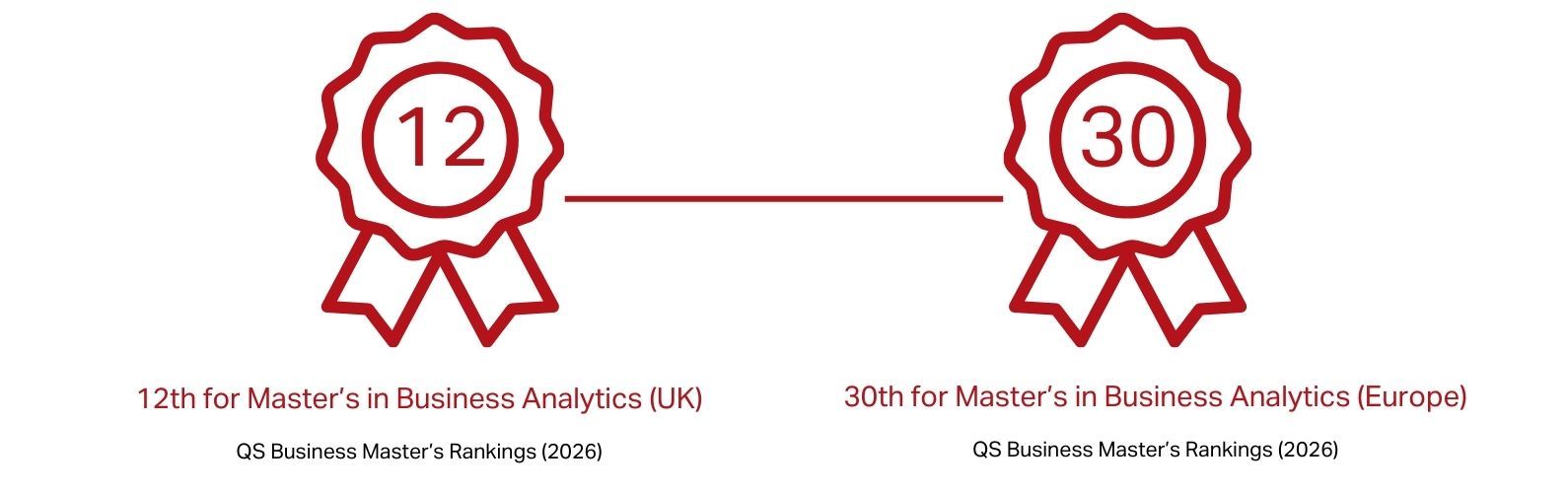
Our MSc Business Analytics covers a combination of technical skills, critical thinking skills and soft skills.
This programme will train you in analytical decision-making. Not only do you learn the theory of business analytics, but also how to apply it in practice. This involves generating relevant business insights using data-driven methodologies and tools. Our programme is one of the few to teach the entire business analytics life cycle, covering descriptive, predictive and prescriptive analytics.
You will enhance your programming in both R and Python, the two most popular languages in the areas of machine learning, statistics and data mining.
You will strengthen your skills in statistics, data analytics and visualisation. You will improve your problem structuring and problem solving. You will also hone your presentation, negotiation, and leadership skills.
All these skills enable you to develop the competence and confidence to contribute to the grand challenges faced by organisations.
Programme structure: We continually review and enhance our curriculum to ensure we are delivering the best possible learning experience, and to make sure that the subject knowledge and transferable skills you develop will prepare you for your future. The University will make every reasonable effort to offer programmes and modules as advertised. In some cases, changes may be necessary and may result in new modules or some modules and combinations being unavailable. Not all optional modules are available every year.
Operational Research and Prescriptive Analytics
In this module, you will be introduced to business analytics, management science, and related disciplines, with a particular emphasis on the modelling and solution of real-world problems.
By the end of this module, you will be able to:
Statistics and Descriptive Analytics
In this module, you will explore a range of statistical methods motivated by real-world business problems, building your ability to select and apply appropriate techniques to address practical challenges across a variety of business contexts.
By the end of this module, you will be able to:
Programming for Data Scientists
In this module, you will develop the programming skills needed to handle complex data science problems, whether you are completely new to programming or an experienced programmer looking to extend your existing skills. You will learn the fundamentals of programming alongside data processing techniques, including visualisation and statistical data analysis. The module also covers problem solving and the development of graphical applications, providing a broad formation to equip you for the most demanding data science tasks.
By the end of this module, you will be able to:
Analytics in Practice
In this module, you will develop analytical thinking at a holistic level and the ability to conduct analytical projects in a real-world context.
By the end of this module, you will be able to:
Optimisation and Heuristics
In this module, you will explore the theory, applications, algorithms, and software tools used in optimisation, with examples drawn from analytics, finance, and data science.
By the end of this module, you will be able to:
Intelligent Data Analysis and Visualisation
In this module, you will be introduced to the fundamental methods and approaches from the interrelated areas of data mining, statistical and machine learning, and intelligent data analysis. You will cover the entire data analysis process, from the formulation of a project objective and developing an understanding of available data and resources, through to statistical modelling and performance assessment.
By the end of this module, you will be able to:
Forecasting and Predictive Analytics
In this module, you will be introduced to the topic of forecasting in business organisations, exploring issues concerned with forecasting model building in regression and its extensions. You will also examine forecasting as it applies to operations and how forecasting can best be improved in an organisational context.
By the end of this module, you will be able to:
Transportation and Logistics Modelling
In this module, you will develop the ability to understand and apply mathematical models in making strategic, tactical, and operational logistics decisions. You will be introduced to emerging logistical concepts and explore the associated mathematical modelling approaches required to address them.
By the end of this module, you will be able to:
Dissertation (Industry)
At the end of the taught modules, you will complete either an applied project, working on a real problem with an organisation from the public or private sector, or a supervised research project, allowing you to investigate a specific topic in depth and engage with the emerging state of the art in your chosen area.
Dissertation (Research)
At the end of the taught modules, you will complete either an applied project, working on a real problem with an organisation from the public or private sector, or a supervised research project, allowing you to investigate a specific topic in depth and engage with the emerging state of the art in your chosen area.
Programme structure: We continually review and enhance our curriculum to ensure we are delivering the best possible learning experience, and to make sure that the subject knowledge and transferable skills you develop will prepare you for your future. The University will make every reasonable effort to offer programmes and modules as advertised. In some cases, changes may be necessary and may result in new modules or some modules and combinations being unavailable. Not all optional modules are available every year.
MSc Direct Entry
Academic:
2:2 Hons degree UK or equivalent.
Specific degree background is required: Completed degree with quantitative methods content (business, engineering, mathematics, sociology etc.)
For specific national curriculum, please view the website.
English:
IELTS 6.5 overall (no band below 6.0)
For other accepted English language tests, please view the website.
Pre-Master’s entry
Applicants who do not meet stated MSc direct entry requirements, may start with a Pre-Master’s programme. Please view full entry requirements here.
Teaching is delivered via a combination of small group lectures and group-based tutorial coursework (oral and written presentation), and assessment is via individual coursework (oral and written presentation) and examinations. You will be encouraged throughout to undertake independent study to supplement what is being taught/learnt and to broaden your personal knowledge.
All modules are delivered in a block teaching, allowing students to concentrate on each subject. All teaching is conducted in English.
German language skills are not required for admission into the programme. You will learn in English, and converse with classmates and academics in English.
All MSc Business Analytics students will receive their postgraduate degree from Lancaster University’s Bailrigg campus in the UK.
Our tuition fee is set for a 12-month time frame encompassing one academic year.
There are two types of fees at Lancaster University Leipzig:
The tuition fee that you will pay depends on your citizenship or your immigration status. International citizens with legal residence in the EU/UK or a EEA member country will be assessed for EU/UK fee status on a case by case basis. The admissions department will provide you with more guidance regarding the fee status review during the application assessment stage.
Eligible students may benefit from various funding options available at Lancaster University Leipzig. Explore what options you may be qualified for.
A Business Analytics degree can be widely applied across the business world. Our graduates at Lancaster University UK go on to work for a wide range of companies, large and small, around the world, in a variety of roles.
Recent graduate destinations include:
The roles our graduates have taken on include:
With data-driven decision-making now central to business success, the demand for professionals skilled in business analytics is rapidly rising across industries. MSc Business Analytics graduates are equipped with a powerful blend of analytical, technical, and strategic skills, enabling them to transform data into actionable insights. This makes them highly valuable in sectors such as finance, healthcare, retail, technology, and consulting. As organisations continue to invest in data capabilities, MSc Business Analytics graduates are exceptionally well-positioned to drive innovation and shape strategic decisions in an evolving business landscape.
For information, visit the Careers Centre at Lancaster University Leipzig.
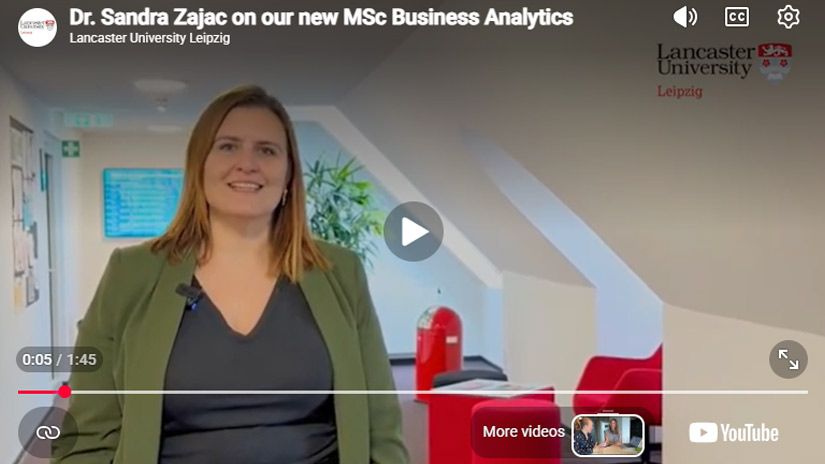
You want to deeply understand how businesses operate and make data-based decisions to optimise it? In only one year you will dive deep into all aspects, Dr Zajac, Assistant Professor in Business Analytics names in this video.