Artificial Intelligence is rapidly transforming industries, public services and everyday life. Addressing the challenges associated with this transformation, LZSCC lecturer Thomas Schmid is the lead author of a new scientific publication for decision-makers, developers and regulators with Springer publishers titled “Managing and Understanding Artificial Intelligence: From Classical to Generative AI”.
Published by Springer Nature in 2026, the book was written by Thomas Schmid, Wolfgang Hildesheim and Taras Holoyad. It provides a comprehensive overview of artificial intelligence, covering both foundational concepts and the latest developments in generative AI. Designed as a practical guide, the publication aims to support managers, AI developers, compliance officers, policymakers, public sector professionals and anyone seeking a deeper understanding of AI technologies and their societal implications.
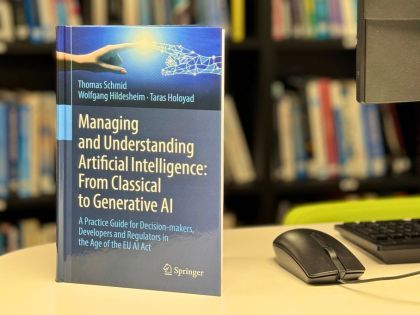
The new book explores a wide range of contemporary AI applications, including self-driving vehicles, medical diagnostics, robotic process automation, customer service chatbots and urban planning. Particular attention is given to generative AI and the disruptive impact of Transformer-based architectures, which have significantly advanced the capabilities of modern AI systems and accelerated innovation across multiple sectors.
A central theme of the publication is the implementation of the European Union’s AI Act. The authors examine how organisations can navigate emerging regulatory requirements while fostering innovation and public trust. The book argues that achieving digital sovereignty and trustworthy AI in Europe requires close collaboration between policymakers, industry leaders and academic institutions.
One of the publication’s key contributions is the introduction of the AI=MC² framework, a classification matrix that evaluates AI systems according to their Methods, Capabilities and Criticality. Building on this framework, the authors propose an “AI Label” transparency seal, designed to support the future classification and assessment of AI products and services. The concept aims to help organisations, regulators and users better understand the capabilities and potential risks associated with AI solutions.
By combining technical foundations, practical applications and regulatory guidance, the book seeks to provide readers with the knowledge required to make informed decisions in an increasingly AI-driven world. To this end, this new publication represents a significant contribution to ongoing discussions about the responsible development and governance of artificial intelligence in Europe and beyond.