Researchers from across Germany and Europe gathered at Lancaster University Leipzig this week for the joint workshop of the GOR Working Group on Financial Management and Investments and the GOR Working Group on Fuzzy Systems, Neural Networks, and Artificial Intelligence, highlighting the growing convergence of artificial intelligence and financial economics.
Held over two days, the event brought together academics and practitioners to explore how emerging technologies are reshaping financial decision-making, risk modelling, and investment strategies in an increasingly uncertain world.
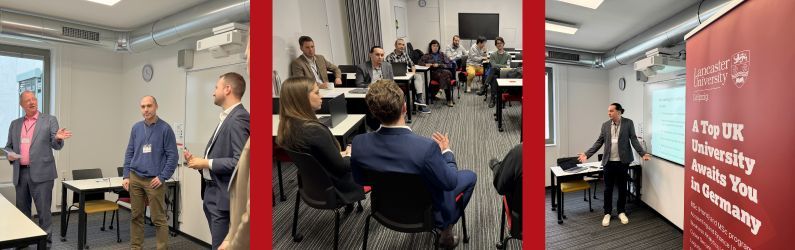
The workshop opened with a strong focus on artificial intelligence in finance, reflecting one of the most dynamic areas of current research. Presentations examined the use of large language models for financial advice, alongside regulatory challenges such as accounting for utility tokens under international financial reporting standards.
Subsequent sessions explored advances in machine learning, including new approaches to regression modelling and critical discussions on evaluating AI systems in business contexts. A recurring theme was the balance between predictive performance and transparency—an issue gaining urgency as AI tools become more widely deployed in financial markets.
A dedicated session on explainable AI (XAI) underscored the importance of trust in automated systems. Researchers presented applications ranging from battery diagnostics to reinforcement learning, demonstrating how interpretability can improve both performance and accountability.
The day concluded with a panel discussion on “Successful and Trustworthy AI,” where experts from academia and industry debated the challenges of deploying AI responsibly. The discussion highlighted the need for interdisciplinary collaboration to address ethical, technical, and regulatory concerns.
On the second day, the focus shifted toward financial markets and investment decisions. Presentations analysed the impact of geopolitical events such as the Arab Spring on commodity prices, as well as the influence of news on stock market behaviour.
Methodological contributions included new approaches to volatility modelling and asset pricing, reflecting ongoing efforts to better capture complex market dynamics.
A central thread throughout the workshop was decision-making under uncertainty. Sessions on dynamic investment strategies and imperfect information examined how tools such as fuzzy logic and robust statistics can support better financial decisions in ambiguous environments.
Topics ranged from sustainable investment timing to portfolio construction under incomplete data, illustrating the breadth of applications for advanced analytical methods.
The workshop demonstrated the increasing integration of operations research, artificial intelligence, and finance. By bringing together diverse perspectives, the event highlighted how methodological innovation can address real-world challenges—from market volatility to the ethical use of AI.
As financial systems grow more complex and data-driven, the discussions in Leipzig suggest that the future of finance will depend not only on technological advances but also on their transparent and responsible application.